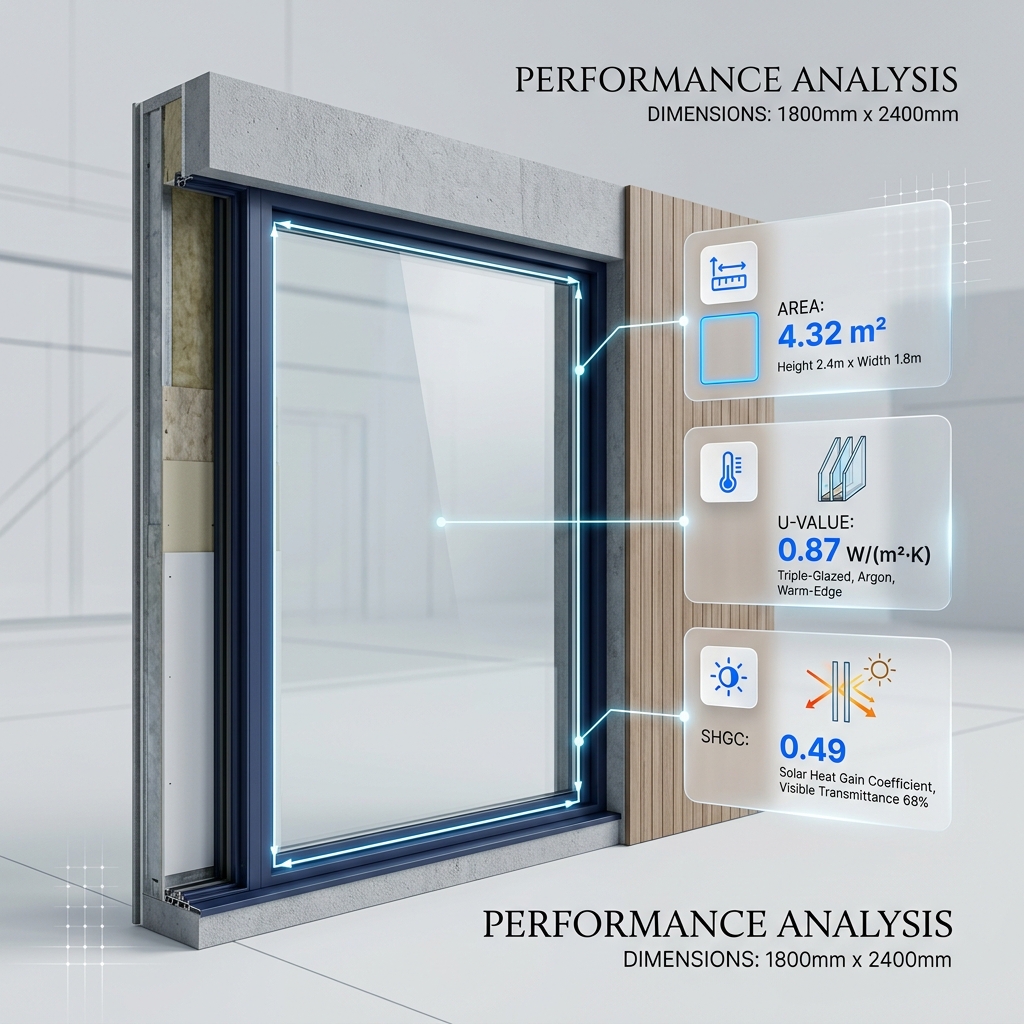
Set up the compliance mindset: envelope, fenestration, nett floor area, U-value and SHGC.
8 minFenestration Fundamentals
Fenestration FundamentalsScope and Key Terms
How to use the diagramRead the visual first, then connect each label to the lesson text and your calculator inputs. The aim is to make every assumption visible before you calculate.
Learning Objective
By the end of this lesson you should be able to decide what must be included in a fenestration check and what information you need before calculating.
Start with the building envelope
Fenestration compliance starts by identifying the parts of the building that separate conditioned interior space from the outside. Windows, glazed doors and roof lights are assessed when they form part of that envelope. Garages, storerooms and similar excluded spaces should only be ignored where the separating construction is itself treated as the envelope.
Use whole-element performance
The performance value used for a window or glazed door should represent the whole fenestration element, not only the centre pane of glass. Frames, spacers and opening type can change the total U-value and SHGC, so supplier data should be checked carefully before entry.
Know the two performance numbers
U-value describes heat transfer through the element. Lower values usually mean better insulation. SHGC describes how much solar heat passes through the fenestration. Lower values usually reduce unwanted solar gain, especially on sun-exposed elevations.
Practice Task
List every external window, glazed door and roof light on one storey.
Mark which items are in conditioned envelope areas.
For each item, record width, height, frame/glazing type, U-value and SHGC.
Calculator Tip
Create one row per window or door type and keep supplier U-value and SHGC evidence with the project record.
Worked Example: First-Pass Fenestration Check
Scenario
A single storey has 52 m2 nett floor area and three glazed elements: 1.8 m2 at U 2.8 / SHGC 0.32, 5.0 m2 at U 2.2 / SHGC 0.25, and 1.1 m2 at U 3.0 / SHGC 0.35.
Calculator Entry
Enter each glazed element with its area, orientation, U-value and SHGC. Use the result cards to check glazing percentage and weighted performance.
Step-by-step method
1Add the three glazed areas to get total fenestration area.
2Divide total fenestration area by nett floor area to get glazing percentage.
3Calculate weighted U-value and SHGC using area x value products.
4Compare the results to the applicable SANS 10400-XA:2021 route and document supplier evidence.
Expected conclusion
The important decision is not only whether the numbers pass, but whether every value can be traced to drawings and supplier data.
Common Mistakes
Using glass-only U-values or SHGC values instead of whole-window values.
Mixing solar and non-solar orientation groups in one weighted average.
Calculating glazing percentage across the whole building instead of per storey.
Quick Knowledge Check
1. What should you confirm before applying this lesson to a project?
Are roof lights separated from vertical fenestration?
2. Which piece of evidence should support the main input in this lesson?
List every external window, glazed door and roof light on one storey.
3. What is the safest action if the information is incomplete?
Flag the missing evidence, use a conservative assumption where appropriate, and avoid claiming compliance until the information is confirmed.
 Fencalc XA2021