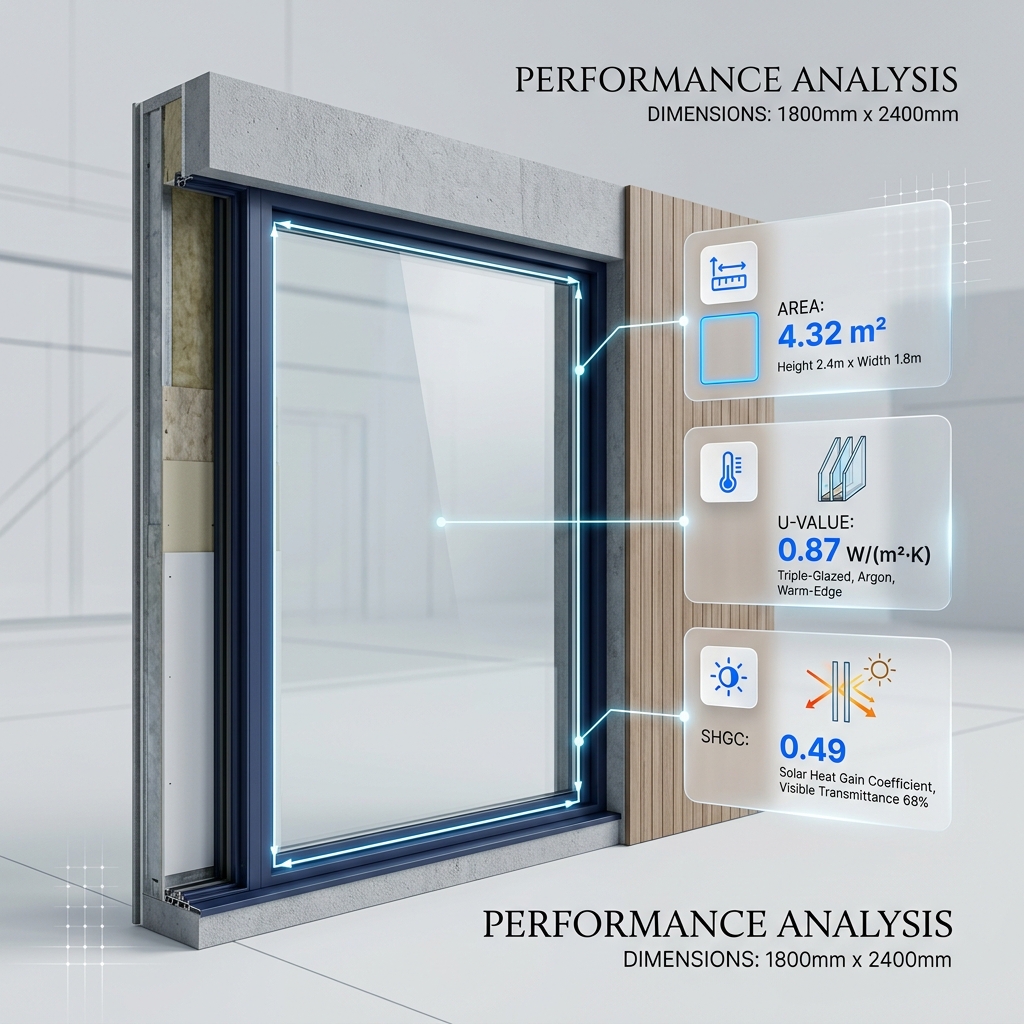
Calculate total fenestration area as a percentage of nett floor area for each storey.
9 minFenestration Fundamentals
Fenestration FundamentalsGlazing Percentage
How to use the diagramRead the visual first, then connect each label to the lesson text and your calculator inputs. The aim is to make every assumption visible before you calculate.
Learning Objective
By the end of this lesson you should be able to calculate the percentage that drives the applicable performance limits.
Calculate per storey
The vertical fenestration percentage is checked per storey. Add the fenestration area for the storey and compare it to that storey's nett floor area. Do not average a large ground floor with a smaller upper floor unless the rule you are applying specifically allows it.
Use total frame-and-glass area
Fenestration area includes the whole opening element: glass plus frame, whether fixed or openable. Use width multiplied by height for each element unless the project has a more precise approved measurement method.
Why the percentage matters
As fenestration percentage increases, the thermal and solar performance requirements become more demanding. A project that passes at a lower glazing percentage may fail after larger doors, clerestories or additional windows are added.
Practice Task
Window A: 1.2 m x 1.5 m. Door B: 2.4 m x 2.1 m. Window C: 0.9 m x 1.2 m.
Calculate total fenestration area.
Divide by a nett floor area of 52 m2 and convert to a percentage.
Calculator Tip
Enter areas consistently. If you enter width and height in millimetres elsewhere, confirm the calculator converts to square metres before comparing percentages.
Worked Example: First-Pass Fenestration Check
Scenario
A single storey has 52 m2 nett floor area and three glazed elements: 1.8 m2 at U 2.8 / SHGC 0.32, 5.0 m2 at U 2.2 / SHGC 0.25, and 1.1 m2 at U 3.0 / SHGC 0.35.
Calculator Entry
Enter each glazed element with its area, orientation, U-value and SHGC. Use the result cards to check glazing percentage and weighted performance.
Step-by-step method
1Add the three glazed areas to get total fenestration area.
2Divide total fenestration area by nett floor area to get glazing percentage.
3Calculate weighted U-value and SHGC using area x value products.
4Compare the results to the applicable SANS 10400-XA:2021 route and document supplier evidence.
Expected conclusion
The important decision is not only whether the numbers pass, but whether every value can be traced to drawings and supplier data.
Common Mistakes
Using glass-only U-values or SHGC values instead of whole-window values.
Mixing solar and non-solar orientation groups in one weighted average.
Calculating glazing percentage across the whole building instead of per storey.
Quick Knowledge Check
1. What should you confirm before applying this lesson to a project?
Was the area calculated for one storey only?
2. Which piece of evidence should support the main input in this lesson?
Window A: 1.2 m x 1.5 m. Door B: 2.4 m x 2.1 m. Window C: 0.9 m x 1.2 m.
3. What is the safest action if the information is incomplete?
Flag the missing evidence, use a conservative assumption where appropriate, and avoid claiming compliance until the information is confirmed.
 Fencalc XA2021