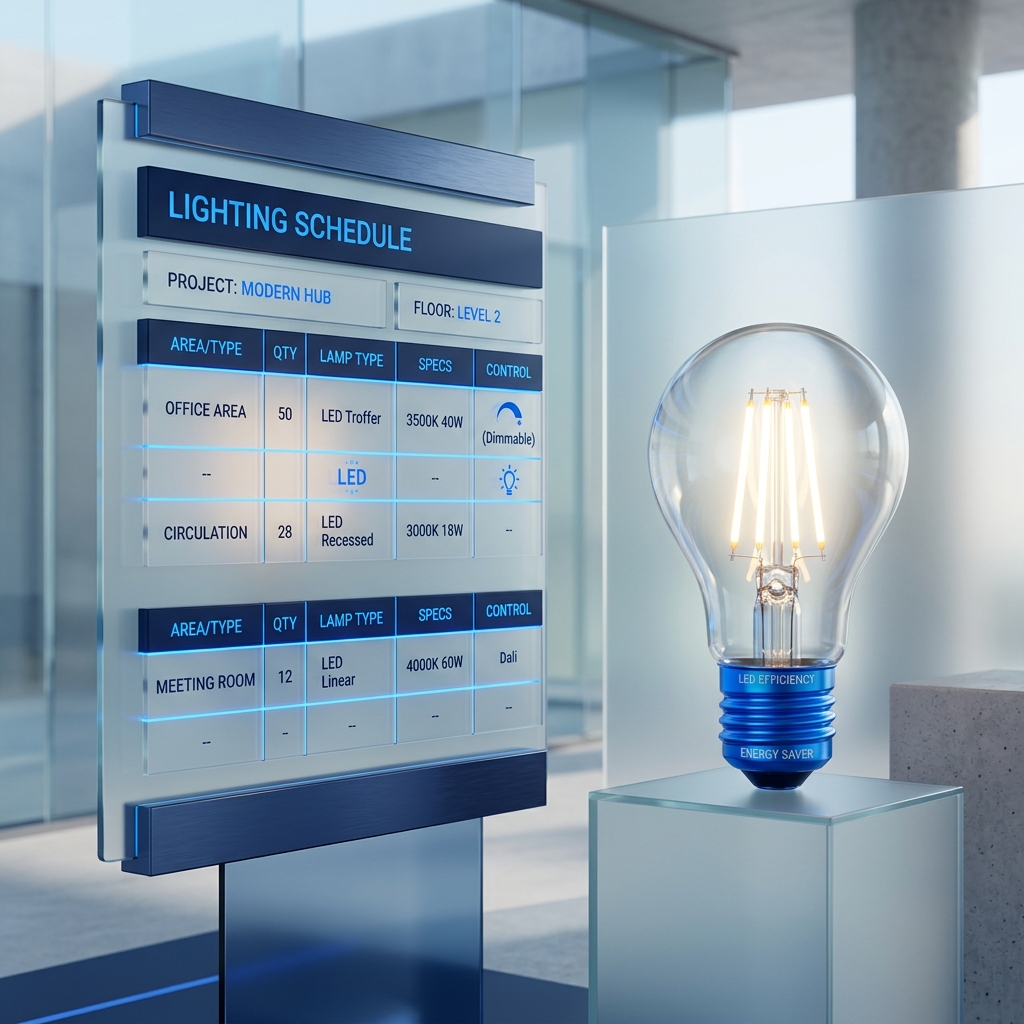
How to use the diagramRead the visual first, then connect each label to the lesson text and your calculator inputs. The aim is to make every assumption visible before you calculate.
Learning Objective
List lighting loads and spaces consistently.
Space-by-space inventory
Lighting compliance begins with a schedule of fittings, spaces and control intent.
Coordinate with Part O
Lighting and ventilation design should be coordinated with the wider building design.
Practice Task
Build a lighting schedule for three rooms.
Record fitting type and wattage.
Calculator Tip
Use consistent room names across lighting and floor-area inputs.
Worked Example: Lighting Schedule Review
Scenario
An office area has LED downlights, perimeter switching and no occupancy sensors.
Calculator Entry
Keep room names consistent with floor-area and services notes.
Step-by-step method
1Create a room-by-room fitting schedule.
2Record fitting type, wattage and quantity.
3Note switching zones and controls.
4Flag substitutions for compliance review.
Expected conclusion
Efficient fittings help, but controls and substitutions still need documentation.
Common Mistakes
Recording fitting wattage without a room-by-room lighting schedule.
Ignoring controls, zoning and occupancy patterns.
Allowing substitutions without checking the compliance effect.
Quick Knowledge Check
1. What should you confirm before applying this lesson to a project?
All spaces are listed.
2. Which piece of evidence should support the main input in this lesson?
Build a lighting schedule for three rooms.
3. What is the safest action if the information is incomplete?
Flag the missing evidence, use a conservative assumption where appropriate, and avoid claiming compliance until the information is confirmed.
 Fencalc XA2021