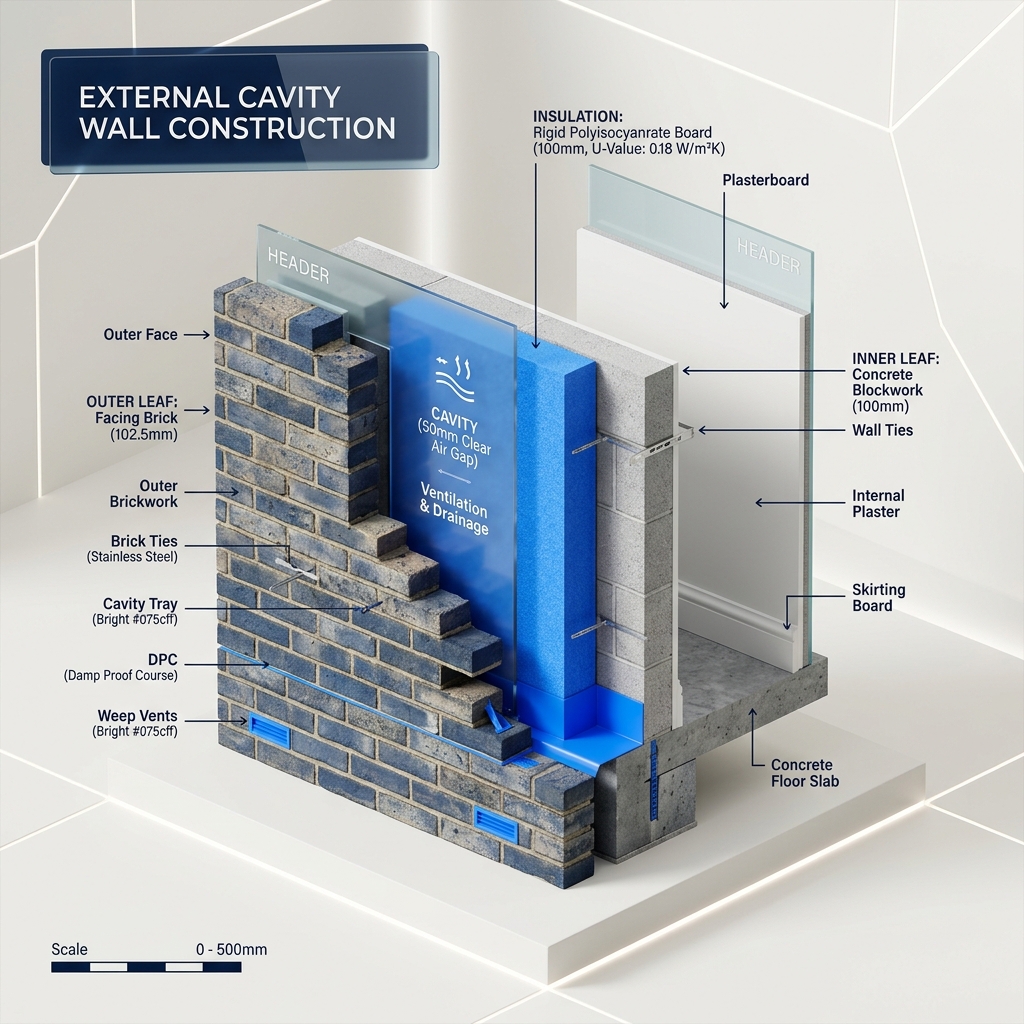
How to use the diagramRead the visual first, then connect each label to the lesson text and your calculator inputs. The aim is to make every assumption visible before you calculate.
Learning Objective
Prepare a wall compliance pack for review.
Specification alignment
The drawing, specification and compliance report should describe the same wall assembly.
Installation matters
Insulation gaps, compression and services can reduce performance if not controlled on site.
Practice Task
Compare wall section, specification and report.
Write a site inspection note.
Calculator Tip
Use comments to record assumptions that need site confirmation.
Worked Example: Wall Build-Up Review
Scenario
A project uses cavity masonry on most elevations and lightweight framed walling at a feature bay.
Calculator Entry
Enter separate wall assemblies where construction differs materially.
Step-by-step method
1Group walls by assembly rather than by elevation only.
2List layers, insulation and thermal bridge risks for each group.
3Check that drawings and specifications describe the same assemblies.
4Keep evidence for each wall type in the report pack.
Expected conclusion
Different wall systems need separate evidence so the report stays reviewable.
Common Mistakes
Reporting a wall value without listing the complete wall build-up.
Missing thermal bridges, lightweight framing or insulation discontinuity.
Letting drawings, specifications and compliance notes describe different assemblies.
Quick Knowledge Check
1. What should you confirm before applying this lesson to a project?
Drawings and specs match.
2. Which piece of evidence should support the main input in this lesson?
Compare wall section, specification and report.
3. What is the safest action if the information is incomplete?
Flag the missing evidence, use a conservative assumption where appropriate, and avoid claiming compliance until the information is confirmed.
 Fencalc XA2021