 Fencalc XA2021
Practical Explanation Guide to SANS 10400-XA:2021
If the full SANS 10400-XA legislation reads like a complicated legal contract, you aren't alone. This guide is designed to break down the "legalese" into understandable chunks.
Instead of reading raw code, below you will find a practical explanation of each major section you need to comply with, what it actually means, and real-world examples.
1. Energy Zones and Orientation (Section 4.2)
What it Means
South Africa is divided into diverse climate zones (ranging from humid coastal areas to dry, freezing highvelds). Because a house in Pretoria experiences heat differently than a house in Cape Town, the regulations require you to identify the specific Energy Zone of your site. Depending on the zone, different minimum insulation and glass requirements will apply. Furthermore, you are required to maximize northern exposure (for winter sun) where possible.
Practical Example
- The Scenario: You are building in Johannesburg (Zone 1 - Medium heating and cooling).
- The Application: SANS 10400-XA requires higher insulation values for your roof (R-Value 3.7) to keep heat inside during cold highveld winters, but allows for more leniency on solar heat gain (SHGC) on north-facing windows than if you were building in hot, humid Durban (Zone 5). You would design the house specifically pulling living areas to face North.
2. Fenestration (Windows & Glass Doors) (Section 5.3)
What it Means
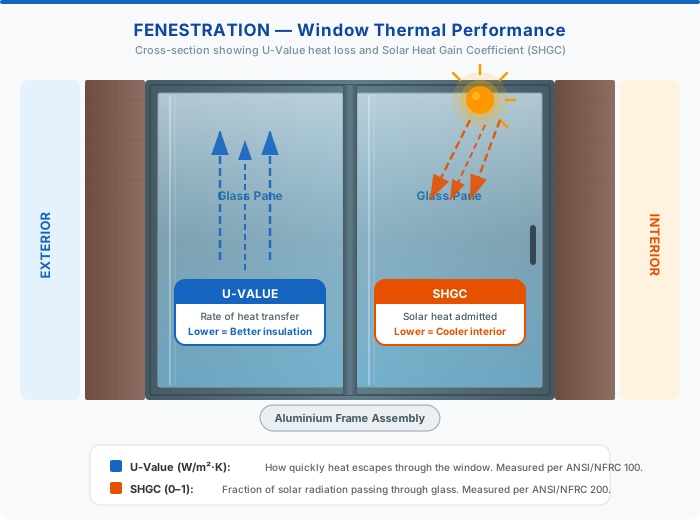
Fenestration is essentially any hole in your wall filled with glass. Glass is the weakest link in your building’s thermal envelope. SANS 10400-XA regulates two main aspects of fenestration:
- U-Value: How much heat escapes out of the window (lower is better).
- SHGC (Solar Heat Gain Coefficient): How much sun heat enters through the window (lower means cooler).
If your total window area exceeds 20% of your floor area, stricter rules apply. As your glass percentage increases (from 25% all the way past 60%), the code demands progressively stricter, high-performance glass to compensate.
Practical Example
- The Scenario: A new modern home with 200m² floor area and huge architectural windows (total glass area = 60m²).
- The Application: 60m² is 30% of the floor area. Because it's over 20%, you must use the standard fenestration tables (SANS 10400-XA Table 4). For a 30% ratio, you can't just use standard 4mm clear glass. You will need to specify High-performance Low-E glass to meet the strict U-Value (max 4.40) and SHGC (max ~0.44) limits for North/East/West facing glass. If you designed it with 60% glass, you'd need extreme double-glazing (U-Value max 2.20)!
3. Floor Insulation (Section 5.4)
What it Means
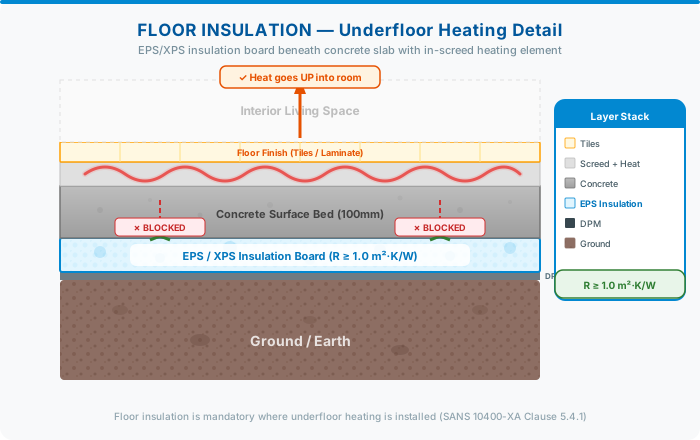
Most concrete slab floors rest directly on the earth, which acts as a massive thermal sink (stealing heat from the house). SANS requires you to insulate the floor depending on your energy zone. Specifically, if you use underfloor heating, you must insulate under the slab regardless of the zone.
Practical Example
- The Scenario: Installing electrical underfloor heating in a living room in Cape Town (Zone 4).
- The Application: Without insulation, you'd end up paying to heat the earth beneath your house. SANS dictates you must place rigid Expanded Polystyrene (EPS) or XPS boarding directly underneath the concrete surface bed prior to casting, ensuring the heat goes up into the room, not down into the dirt.
4. Wall Insulation (Section 5.5)
What it Means
Standard 230mm double-brick walls do not have adequate thermal resistance on their own in many energy zones. The code dictates a minimum "R-Value" (Resistance value) for external walls. If you are building with heavy masonry (bricks/blocks), you often need to introduce cavity insulation or external plaster insulation.
Practical Example
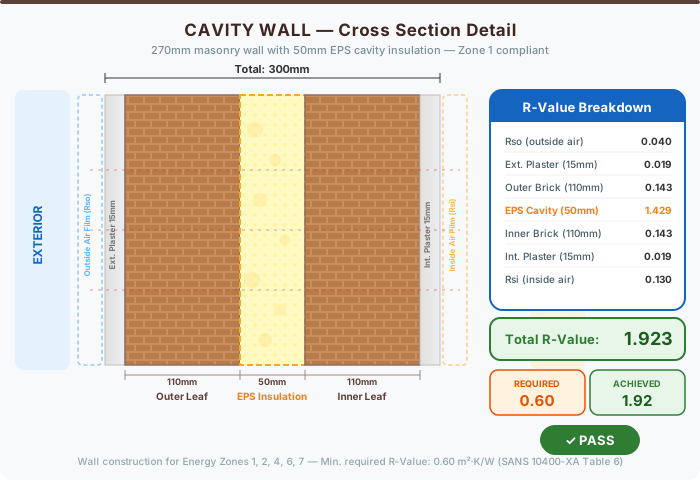
- The Scenario: A standard double-brick (230mm) wall in a cold zone. The standard brick only provides an R-value of about 0.35, but the law requires an R-value of 0.60.
- The Application: You build a Cavity Wall (two 110mm brick skins with a 50mm gap). Instead of leaving the gap empty, you place a 50mm high-density polystyrene (EPS) board inside the cavity. This simple addition skyrockets the wall's R-Value to over 1.5, heavily exceeding compliance and keeping the ambient indoor temperature stable during winter.
5. Roof Assembly Insulation (Section 5.6)
What it Means
Heat rises. An uninsulated roof is the number one cause of winter heat loss and summer heat gain. SANS 10400-XA lists strict minimum R-Values for the entire roof assembly based on the energy zone (e.g., R-Value 3.7 for Zone 1 and 2, but R-Value 2.7 for Zone 5).
Practical Example
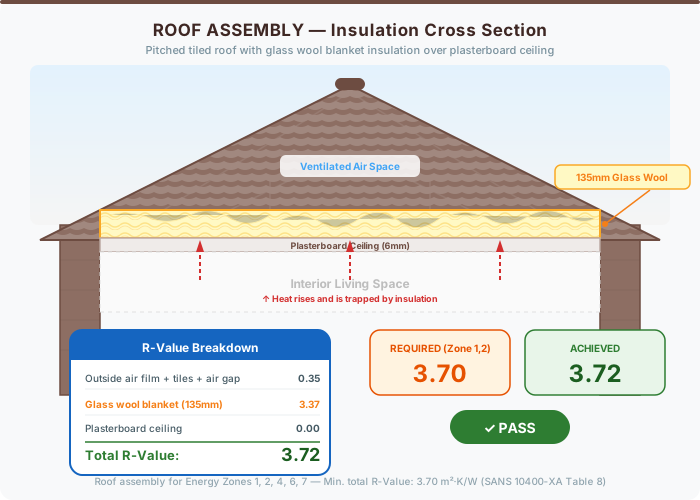
- The Scenario: A home with a standard pitched tiled roof in Pretoria (Zone 2). The tiles and plasterboard ceiling combined only give an R-value of about 0.35. The required limit is 3.7.
- The Application: You must specify bulk insulation. Adding a 135mm Glass-wool blanket (e.g., Aerolite) laid over the ceiling boards adds an R-Value of 3.37. (0.35 + 3.37 = 3.72). You have now passed compliance.
6. Hot Water Heating (Section 6.1)
What it Means
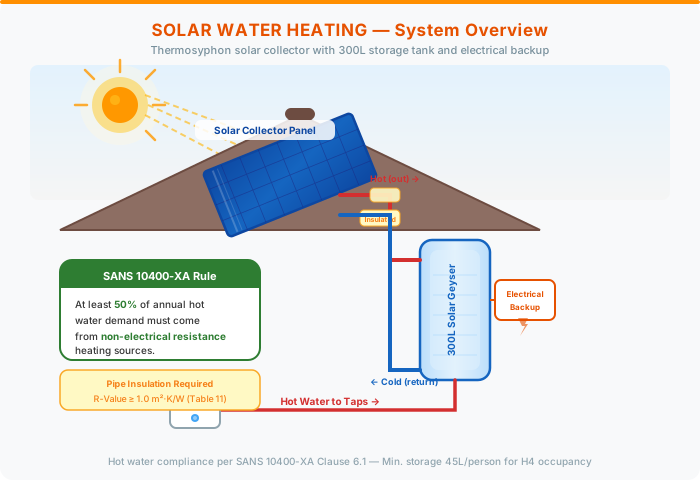
Heating water accounts for a massive chunk of a home's electricity usage. The law is very strict here: At least 50% by volume of your average annual hot water requirement cannot be heated by an electrical resistance element (standard geyser). Furthermore, all exposed hot water pipes must be insulated.
Practical Example
- The Scenario: A new family home requiring a 200 Litre geyser. You cannot just install a standard 200L electric geyser from a hardware store.
- The Application: You must install either a Solar Water Heating System, a Heat Pump, or a Gas Geyser. If using solar, the tank size must be generously sized (e.g., 300L instead of 200L) to store enough hot water to act as a thermal battery for cloudy days. All hot water pipes in the roof space must be wrapped in generic foam pipe lagging (minimum R-Value 1.0).
7. Lighting (Section 6.2)
What it Means
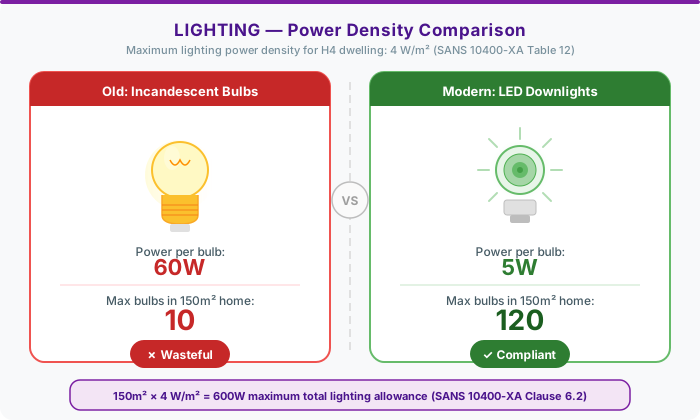
SANS caps the maximum amount of energy your lights can draw based on the floor area of the building. For a dwelling house, the total lighting power density cannot exceed 4 Watts per square meter (W/m²).
Practical Example
- The Scenario: A 150m² dwelling. The maximum allowable electrical draw for the entire lighting network is 600 Watts (150m² × 4 W/m² = 600W).
- The Application: In the old days of 60W incandescent bulbs, 600 Watts meant you could only install 10 lights in the entire house! Today, by strictly specifying LED downlights (which draw ~5W each), you can install up to 120 lights in the exact same house and remain perfectly compliant.
8. Space Air Conditioning (Section 6.3)
What it Means
You cannot install highly inefficient, power-hungry air conditioners. All installed HVAC units must meet a minimum Coefficient of Performance (COP). The COP dictates how much heating/cooling energy the unit provides relative to the electrical energy it consumes.
Practical Example
- The Scenario: Installing split-unit wall air conditioners in the bedrooms.
- The Application: You must ensure the units have a Cooling COP (COPC) of at least 3.0. This basically means for every 1 kW of electricity the unit draws from the grid, it must pump at least 3 kW of cooling power into the room. This effectively mandates the use of modern Inverter Air Conditioners.